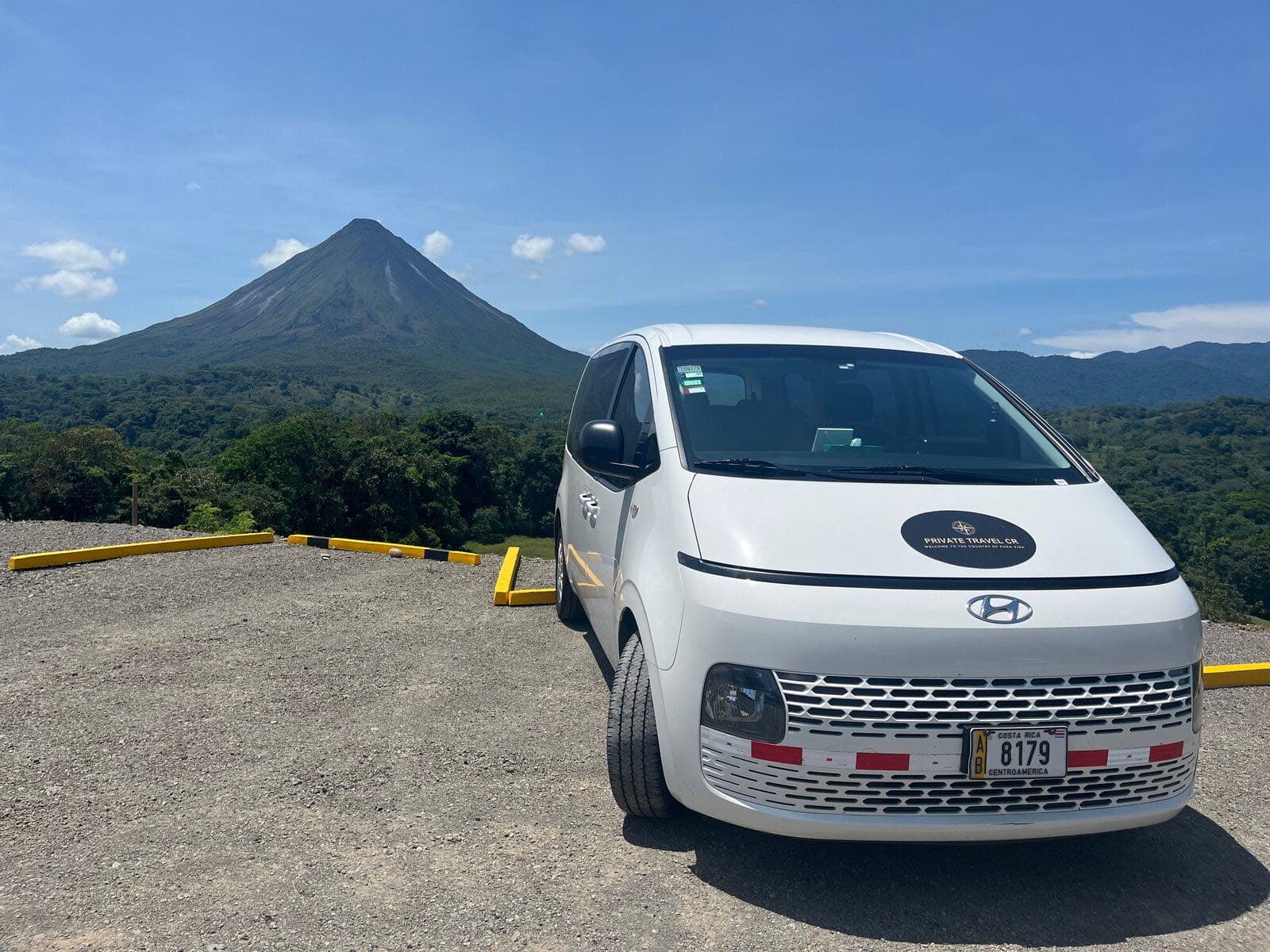
La Fortuna is the single most-visited destination in Costa Rica that isn't a beach. We drive guests in and out of it every day from both airports, and the planning questions are remarkably consistent: where exactly is it, is it worth the drive from SJO, how many days do I need, which hotel actually has the volcano view, and what do I do with all of it?
This guide answers each one in order, with what we'd tell our own family if they were visiting. It's not a list of every activity — there are other posts for that. It's the planning brain: how to fit La Fortuna into a Costa Rica trip without wasting a day.
Where La Fortuna actually is
La Fortuna sits at the base of Arenal Volcano in the northern lowlands of Costa Rica, in the canton of San Carlos in the Alajuela province. On a map it's roughly in the middle of the country, 135 km north of San José and 145 km southeast of Liberia.
What makes it special isn't the town itself — La Fortuna town is small (about 15,000 people) with a single church, a soccer field, and a few blocks of restaurants and shops. The draw is the 2 km-wide active stratovolcano that dominates every view, the rainforest surrounding it, the hot springs flowing from the volcano's geothermal heat, and the wildlife (sloths, monkeys, toucans, frogs) you can see without even trying.
Arenal Volcano was the most active volcano in the Americas from 1968 until 2010, when it entered a resting phase. It still steams from the top on clear days, and the geology of the area — hot springs, lava fields, fertile soil — is all because of it.
How to get to La Fortuna
There are two airports in Costa Rica and both work for La Fortuna. Pick based on what else is on your itinerary.
From SJO (Juan Santamaría Int. Airport — San José)
The most common option. 3 hours by private shuttle, 135 km, via Route 1 to Naranjo, Route 141 through Zarcero (don't miss the topiary church), and Route 142 into La Fortuna.
If you're flying in from North America or Europe, SJO usually has cheaper flights. The drive is fully paved and our drivers know every curve.
We wrote a detailed breakdown of the SJO → La Fortuna route here, including timing tips, lunch stops, and what to pack for the drive.
Direct booking: private shuttle from SJO to La Fortuna.
From LIR (Liberia Int. Airport — Guanacaste)
3 hours, 145 km, via the Pan-American Highway south to Cañas, then Route 142 around Lake Arenal. The Lake Arenal stretch is one of the most beautiful drives in Costa Rica when the volcano is visible.
LIR makes sense if you're combining La Fortuna with Guanacaste beaches (Tamarindo, Conchal, Papagayo) — saves you the back-and-forth.
Direct booking: private shuttle from LIR to La Fortuna.
Going back to the airport
Same drive, same price, and the one people book late. La Fortuna → SJO is $220 and 3 hours; La Fortuna → LIR is $225 and 3 hours.
The thing worth knowing: for a flight before 10 a.m. out of SJO you want a 4 or 5 a.m. pickup, because morning traffic entering the San José metro area adds 30–45 minutes that Google Maps won't show you. Most La Fortuna hotels will make you a breakfast box if you ask the night before.
Driving yourself
You can rent a car, but most travelers don't need to. Once you're in La Fortuna, attractions are mostly within a 30-minute radius and every hotel coordinates transport to tours. Renting just to drive 3 hours each way, pay for parking, and worry about insurance is a poor trade for most itineraries.
The bus
Public bus exists — about 5 hours from SJO with a transfer in Ciudad Quesada, $7 USD one way. It's the cheapest option, but you arrive at the public terminal and still need a taxi to your hotel. Backpacker territory.
Best time to visit La Fortuna
La Fortuna has rainforest climate — it's warm year-round (24–28°C / 75–82°F at low elevation, cooler in the surrounding hills).
There are two distinct seasons that matter for planning:
Dry season — December to April. The peak. Clear volcano views most mornings, less rain on hikes, but prices peak and hotels book out 4-6 months ahead for Christmas/New Year and Easter (Semana Santa). Mid-Feb through March is the sweet spot if you want dry weather without the holiday crowds.
Green season — May to November. Rain in the afternoons, dramatic skies, fewer tourists, hotels 30-40% cheaper. The volcano is often shrouded in cloud but the rainforest is at its most vibrant. May/June and late October/November are the best windows — warm rains, but the worst of the wet stuff is September-October when you can have full days of downpour.
September & October specifically: these are the wettest months. We don't recommend La Fortuna as a primary destination then. The hot springs and indoor activities still work, but volcano photography is almost impossible and waterfall hikes can get slippery.
For a deeper breakdown including what to pack, see our Costa Rica seasons guide.
How many days do you need in La Fortuna?
This is the single most-asked question.
- 2 nights — minimum to feel anything other than rushed. You can do 1 hot springs evening + 1 volcano-area activity (waterfall hike, hanging bridges, or a wildlife tour).
- 3 nights — the sweet spot for most travelers. Lets you do 2-3 main activities plus a relaxed day at hot springs and time to actually enjoy your hotel.
- 4-5 nights — if you want to add a day trip to Río Celeste or Caño Negro, or if you booked a hotel with serious amenities (Tabacón, Nayara, The Springs) and want to actually use them.
The mistake we see most: people book 1 night, arrive at 6 PM, leave at 8 AM, and never see the volcano because it's clouded both mornings. Don't do 1 night.
Where to stay in La Fortuna
There are 100+ hotels in the La Fortuna area. The differences aren't subtle — luxury hot springs resorts cost $400-800/night while comfortable mid-range bungalows are $100-200. We've curated 25 of them with shuttle pricing for each:
The luxury flagships (over $400/night)
These are the destination-resorts where the hotel IS part of why you came:
- Tabacón Thermal Resort & Spa — natural hot springs running through the property, the most iconic stay in CR
- Nayara Springs — adults-only luxury with private plunge pools, consistently ranked among the world's top hotels
- Nayara Tented Camp — safari-style luxury tents added in 2024, the newest Nayara property
- The Springs Resort & Spa — 28 hot springs pools and a wildlife rescue on-site
- Amor Arenal — adults-only boutique with private hot springs plunge pools in each villa
Premium mid-range ($200-400/night)
Excellent properties with hot springs and volcano views but without the destination-resort price:
- Arenal Kioro Suites & Spa — suite-only with private hot springs river
- Arenal Springs Resort & Spa — family-friendly with multiple thermal pools
- Arenal Manoa Hotel & Spa — adults-friendly with infinity pool and volcano views
- Volcano Lodge Hotel & Thermal Experience — family-owned with thermal pools
Mid-range and family-friendly ($100-200/night)
- Hotel Mountain Paradise — popular with families
- Hotel Magic Mountain — hilltop with panoramic volcano views
- Hotel Los Lagos Resort — hot springs + butterfly garden + water slides
- Baldi Hot Springs Hotel — 25 thermal pools (the largest in CR), great for families
For the unique stays (Arenal Observatory Lodge inside the national park, the rest of the Nayara family), see the full La Fortuna hotel list.
What to do in La Fortuna
The honest top picks, ranked by what we'd send our own family to do:
- Hot springs at sunset — even if you stay at a hotel without them, Baldi or Tabacón both sell day passes. The cooler air + warm volcanic water + a beer is one of those Costa Rica memories that sticks.
- La Fortuna Waterfall — 500 stairs down to a 70m waterfall, swim at the base. Open 7 AM – 5 PM, $18 entry.
- Mistico Hanging Bridges — 3 hours of suspended walkways through the rainforest canopy. Best for wildlife — guides are worth it.
- Wildlife night tour — guides find sloths, frogs, snakes you'd never spot on your own. ~3 hours, $50-70 per person.
- Río Celeste day trip (if you have 4+ nights) — the famous turquoise river, 2 hours each way.
We wrote a full top-10 things to do in La Fortuna with the details (prices, when to book, what to skip).
Where to eat in La Fortuna
The food in La Fortuna is better than you'd expect from a small town. Tourist-trap traps exist on the main street but our restaurant guide breaks down the actual spots — including the family-run sodas where you'll eat a full plate for $8.
Quick picks:
- Don Rufino — special-occasion dinner ($25-45/person)
- Soda La Hormiga — the local breakfast spot ($6-10/person)
- Lava Lounge — casual dinner with vegetarian options
- Restaurante Nene's — local tica food in a relaxed setting
Day trips from La Fortuna
If you have 4+ nights, these are the day trips that justify the time:
- Río Celeste & Tenorio National Park — 2 hours each way, $25 park entry. The most photographed waterfall in CR.
- Caño Negro Wildlife Refuge — boat tour through wetlands, exceptional bird and crocodile watching.
- Poás Volcano — only on Tuesdays (currently the only day it's open after activity), needs full day.
- Bajos del Toro / Río Agrio — adventurous detour to a hidden canyon, requires a 4x4 or private driver.
Practical info you'll actually use
- Currency: USD widely accepted in tourism. Local prices in colones (CRC). ATMs at the BAC and BCR branches on the main street.
- Cell service: Excellent in town, patchy in the volcano-area resorts. WiFi included at every hotel above mid-range.
- Safety: La Fortuna is one of the safest towns in Costa Rica. Standard travel precautions apply — don't leave valuables in the car, use the hotel safe.
- Tipping: Restaurants add a 10% service charge automatically; tipping above that is optional. Tour guides typically receive $5-10/person/half-day.
- Plugs: Same as USA (Type A/B, 110V). No adapter needed for North American devices.
- What to pack: Light layers (cooler at night and at higher elevations), rain jacket regardless of season, water shoes for hot springs and waterfall, a real flashlight for night tours.
Pro tips from someone who lives here
- Book the Tabacón / Nayara hot springs at sunset (4-5 PM start), not midday. The temperature swing is more dramatic and the photos are unreal.
- Don't book the volcano hike for your last day. If clouds roll in, you've lost your only shot. Schedule it on day 2 or 3.
- Mistico Hanging Bridges in the morning, not afternoon. Wildlife is more active and rain is less likely.
- The "Sky" attractions (Sky Tram, Sky Trek) are at a separate area called Sky Adventures Arenal — give yourself a full half-day if you go.
- The cheapest hot springs option for non-hotel-guests is Las Termales Los Lagos or the public river at Tabacón Falls (free, locals know the spot, ask your driver).
How to get from La Fortuna to your next stop
The most common onward connections, with one-click booking:
- La Fortuna → Monteverde (3.5 hours by road, or 3 hours via jeep-boat-jeep across Lake Arenal)
- La Fortuna → Manuel Antonio (5.5 hours)
- La Fortuna → Tamarindo (4.5 hours)
- La Fortuna → SJO Airport (3 hours)
- La Fortuna → LIR Airport (3 hours)
Frequently asked questions
Is La Fortuna worth visiting? Yes — it's the most iconic single stop in any Costa Rica itinerary, and the only place where you can stay at the base of an active volcano with natural hot springs flowing through your hotel. The only travelers who skip it are beach-only itineraries focused on Guanacaste.
Can you see Arenal Volcano erupt? Not anymore — Arenal entered a resting phase in 2010. You can still see steam from the top on clear days, and the geology + hot springs are all because of past activity.
How safe is La Fortuna at night? Very. La Fortuna town is small, well-lit, and tourist-friendly. The main concern is wildlife on the roads if you're driving back to a hotel outside town — go slow, especially in rainy weather.
Are hot springs included with hotels? Depends on the hotel. Tabacón, Nayara, The Springs, Arenal Kioro, Arenal Manoa, Baldi, Los Lagos and several others have on-site hot springs included for guests. Most mid-range hotels do not — but day passes to the resorts above are easy to buy.
Can I combine La Fortuna with the beaches in one trip? Absolutely — it's the most common Costa Rica itinerary. Most people fly into one airport (SJO or LIR), do La Fortuna for 3-4 nights, then go to a Pacific beach (Manuel Antonio if flying out SJO, Tamarindo / Conchal / Papagayo if flying out LIR) for 3-5 nights.
What's the closest airport to La Fortuna? SJO and LIR are roughly equidistant (3 hours each by car). There's also a small domestic airport (FON) right in La Fortuna for charter flights, but commercial service is currently limited.
Ready to plan your La Fortuna trip? Get an instant shuttle quote or message us on WhatsApp — we'll help you fit La Fortuna into your itinerary in 5 minutes.