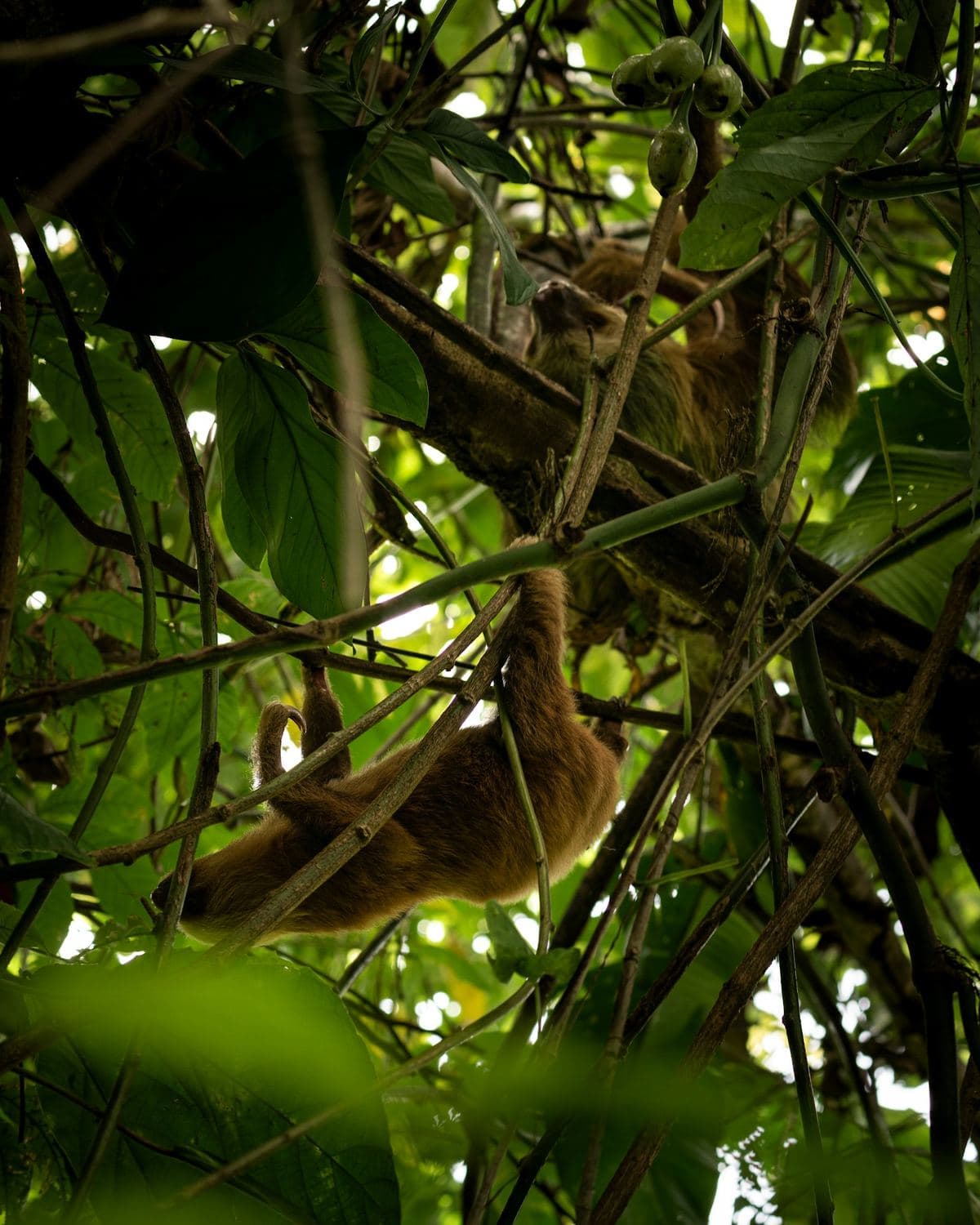
I get this question every other transfer: "Where can we actually see a sloth?" After hundreds of trips around Costa Rica, here's the honest shortlist — what works, what doesn't, and how to maximize your chances.
First, a quick reality check. Sloths in the wild are slow, motionless, and the color of tree bark. Most travelers walk right past them without realizing. Your single best move is to hire a park guide at any national park entrance ($20–30 per group). Their trained eyes (and spotting scopes) will find you 10x more wildlife than you'd see alone.
Costa Rica's two sloth species
Both species live across Costa Rica:
- Three-toed sloth (Bradypus variegatus) — the "smiling" one. Active during the day, eats only leaves, slightly easier to spot.
- Two-toed sloth (Choloepus hoffmanni) — slightly bigger, nocturnal, eats fruit and leaves. You're more likely to see one sleeping during the day, curled up like a fuzzy ball high in the canopy.
About 70% of sloth sightings on tours are three-toed because they're more active during the hours guides operate.
1. Manuel Antonio National Park — The #1 Spot
If you only have one shot at a sloth, come here. The park is small, well-trailed, and dense with wildlife — guides routinely spot 3–5 sloths per group on a 3-hour morning tour. You'll likely also see white-faced capuchin monkeys, howler monkeys, sometimes squirrel monkeys, plus iguanas and tons of birds.
- Cost: $20 USD park entrance + $25-30 USD per person for a certified guide
- Best time: Open 7am, get there by 7:15am — animals are most active before 10am
- Closed: Tuesdays
- Tip: Buy park tickets online in advance (sinac.go.cr) — they sell out daily in high season
See our shuttle to Manuel Antonio →
2. Cahuita National Park — Caribbean Sloth Capital
On the Caribbean coast about an hour south of Limón. Cahuita has some of the highest sloth densities in Costa Rica — locals and biologists routinely cite it as the easiest place to see them in the wild. Park is donation-based (suggested $10 USD), so it's also the budget option.
- Cost: Suggested $10 USD donation at the Kelly Creek entrance + $20-30 USD per person for a guide
- Best time: Morning, 8–10am. Bring water, the humidity is intense
- Bonus: White-faced capuchins, howler monkeys, raccoons, agoutis, snakes, and a coral-reef beach at the end of the trail
- Tip: The local guides at the entrance are some of the best in the country — many grew up walking this forest
3. Bogarín Trail (La Fortuna) — Locals' Hidden Gem
A privately-owned trail on the eastern edge of La Fortuna town that almost guarantees sloth sightings. Easier to walk than a national park (flat boardwalks), less crowded, and the resident guides spot wildlife you'd never find on your own. Caimans in the swamp, toucans, dart frogs, plus 5-10 sloths on most visits.
- Cost: $30 USD per person including a guide (you can't enter without one)
- Best time: Anytime — they take groups every hour. Early-morning slots have the most active sloths
- Duration: ~2 hours
- Why we love sending guests here: It's a 5-minute drive from any La Fortuna hotel, kid-friendly trails, and the sighting hit-rate is essentially 100%
4. Mistico Hanging Bridges (La Fortuna)
The famous hanging-bridges park near Arenal Volcano. The walk takes you through primary rainforest with bridges crossing 16 canyons — sloths are common in the upper canopy, and being eye-level with them on a hanging bridge is a different experience than craning your neck from the ground.
- Cost: $30 USD entry (self-guided) or $50 USD with a guide
- Best time: First slot of the day (7:30am) — beat the tour-bus crowds
- Duration: 2-3 hours
- Bonus: You're inside Arenal Volcano National Park territory — volcano views on a clear day
5. Sloth Sanctuary of Costa Rica (Cahuita)
A rescue and rehabilitation center near Cahuita, founded in 1992. They've cared for hundreds of orphaned and injured sloths. The standard tour walks you through the nursery (baby sloths in baskets) and a canoe ride through the surrounding wetlands. This is a rescue facility, not a "petting zoo" — you observe sloths, you don't hold them, and that's the right ethic.
- Cost: Around $30 USD per person for the standard tour
- Best time: Morning tours
- Duration: 2 hours
- Important: If a place offers you a "sloth selfie" or to "hold a sloth," that's a red flag. Sloths are wild animals, stressed by human contact, and shouldn't be handled by tourists. Skip those.
6. Toucan Rescue Ranch (San José area)
A rescue center 30 minutes north of San José in San Isidro de Heredia. Sloths, toucans, owls, monkeys — all animals that can't be returned to the wild. Their educational tour is one of the best in the country for actually understanding sloth biology and conservation.
- Cost: ~$60 USD per person for the public tour
- Best time: Morning tours
- Why it's worth the price: Tours are kept small, the staff are passionate biologists, and money goes to actual conservation. Perfect for travelers staying in San José who want a half-day wildlife experience.
7. Selvatura Park (Monteverde)
Best known for zip lines, but Selvatura also has a hanging-bridges section plus a small sloth-focused trail. Not the highest sloth density on this list, but if you're already in Monteverde for the cloud forest and want to combine zip lines + wildlife + bridges in one day, this works.
- Cost: $50 USD bridges-only, more for the combos
- Best time: Morning
- Realistic expectation: 1-2 sloth sightings on a good day. Bogarín is a more reliable bet if sloths are your main goal.
How to maximize your chances
A few things we've learned driving guests to these spots:
- Hire a guide. Always. Even if you've seen wildlife elsewhere — Costa Rican guides spot 5-10x more than self-guided visitors. The $25-30 per person is the best money you'll spend.
- Go early. 7-10am is the magic window. Wildlife is active before the heat, and the parks are quiet.
- Look UP, slowly. Sloths live high in the canopy. Most travelers scan ground-level and miss them entirely.
- Bring binoculars if you have them. A 8x42 pair changes everything. You can rent them at most park entrances for $5-10 USD.
- Move slow. Sloths don't react to motion as long as it's calm. Loud groups scare off the other wildlife you'd see along the way.
- Don't expect close-ups. Sloths in the wild are usually 30-50 feet up. They're not the cuddly photo subject Instagram makes them look like. The reward is seeing one in their actual habitat — far more meaningful than a zoo encounter.
Sloth tourism — places to skip
A reality-check section, because some travelers ask:
- Anywhere offering "hold a sloth" or "sloth selfie" tours. These are almost always exploitative. Sloths get stressed by handling, and ethical sanctuaries do not allow physical contact with guests.
- Roadside attractions with caged sloths. A handful exist on the Caribbean and Pacific routes. They're not rescue centers, they're roadside attractions. Skip.
- Don't feed sloths. A small but vocal group of tourists offers bananas or leaves to "wild" sloths along trails. Sloths' diets are highly specialized — most fruit will literally make them sick. If a guide is doing this on your tour, find a different guide.
What if I'm only in La Fortuna or Manuel Antonio?
You'll see sloths. Both regions have multiple high-reliability options.
- In La Fortuna: Book Bogarín Trail (guaranteed) or Mistico Hanging Bridges (likely). Add a sloth sanctuary day trip if you have time — there's also a smaller sloth refuge in Bijagua, about 90 minutes north.
- In Manuel Antonio: A guided park tour will almost certainly find you sloths in 2-3 hours.
- In Tamarindo / Guanacaste: Tougher — the dry tropical forest there isn't ideal sloth habitat. You can do a day-trip to a sloth sanctuary in Diamante, but most people see their sloths elsewhere on the trip.
How to combine sloth-spotting with your itinerary
If sloths are a priority, the easiest plan is to build your trip around either Manuel Antonio or La Fortuna — both have multiple high-reliability spots within 15-30 minutes of any hotel. Adding a Caribbean leg to Cahuita is the most rewarding upgrade for nature-focused travelers, but it adds a long drive day.
We've moved guests on every combination of these — from a single-day Manuel Antonio sloth tour to a full "see all the wildlife" Caribbean + Pacific itinerary. If you book a shuttle with us and let the driver know sloths are a priority, we'll often suggest a 15-minute roadside detour to a known sloth tree on the way to your hotel. La Fortuna and the Caribbean route have several.
FAQ
Are sloths easy to find in Costa Rica? With a guide, yes. Without one, far less so. Sloths are slow and motionless, blending into the canopy. Hiring a park guide ($20-30 per person) is the single best move to actually see them.
What is the best time of day to see sloths? Early morning, 7-10am. Three-toed sloths are diurnal and most active in the cool hours. Park guides also work mostly in the morning, so wildlife-spotting is at its peak.
Where in Costa Rica has the most sloths? The Caribbean coast — specifically Cahuita National Park and the surrounding area near Puerto Viejo — has the highest sloth density in the country. Manuel Antonio on the Pacific is the most visited spot for sloth sightings because it's compact and accessible.
Can I see sloths in Manuel Antonio without a tour? You can, but you'll see far fewer. The trained guides at the park entrance routinely find 3-5 sloths per group. Going alone, most travelers see 0-1.
Is the Sloth Sanctuary worth it? Yes, if you're interested in conservation and rehabilitation, not just photos. It's a real rescue facility with decades of work behind it. Don't expect to hold or pose with the sloths — ethical sanctuaries don't allow that, and that's the right approach.
Are there sloths in San José? Not in the city itself, but Toucan Rescue Ranch is 30 minutes north in San Isidro de Heredia, and gives you a high-quality sloth encounter on a half-day trip from your hotel.
What's the difference between two-toed and three-toed sloths? Three-toed sloths are smaller, diurnal (active during the day), and only eat leaves. Two-toed sloths are larger, nocturnal, and eat fruit and leaves. Most daytime sightings are three-toed.
Can sloths really not move on the ground? They move, but very slowly and only when necessary (about once a week to defecate). On the ground they're vulnerable to predators, so they avoid descending. Most of their life happens 30-100 feet up in the canopy.
Book a private shuttle to Manuel Antonio → · Book a shuttle to La Fortuna →