The short answer: no, you don't need to speak Spanish to travel in Costa Rica. Most tourists get through a week here without speaking a single word of it.
The longer answer, which I'll give you below, is that a little bit of Spanish makes the trip noticeably better — kinder service in restaurants, easier transactions at small shops, and warmer interactions in the places that aren't on the tour bus map. You don't need to be conversational. You need maybe 20 phrases.
I'm Costa Rican. I run a shuttle company, my drivers all speak English, and I've sat in the front seat of thousands of pickups translating between confused tourists and very chill Tico drivers. Here's what's actually true about language and travel in Costa Rica.
Where English is essentially universal
If your trip is in the standard tourist circuit, you can get through it in English alone. The places where you will basically never need Spanish:
- Both international airports (SJO in San José, LIR in Liberia). Every counter, every taxi stand, every shuttle desk, every immigration officer.
- Major hotels — anywhere over $100/night essentially. Even most boutique guesthouses train front desk staff in basic English.
- All major tour operators. Ziplines, hot springs, raft trips, hiking guides — these companies hire bilingual guides.
- La Fortuna town center. Almost every restaurant, gift shop, and tour booth has English-speaking staff. We're 100% tourism-dependent.
- Tamarindo. Probably the most English-friendly beach town in the country.
- Manuel Antonio / Quepos. Same — tourism-dominated.
- Monteverde / Santa Elena. English-friendly throughout.
- Puerto Viejo (Caribbean). English plus Caribbean English Creole — locally accented but understandable.
- All shuttle drivers in the major companies (including ours).
If your itinerary is fly into SJO → La Fortuna → Manuel Antonio → fly out, you can do the whole trip with zero Spanish. That's actually the most common trip we drive. See our SJO to La Fortuna shuttle guide for one example.
Where Spanish helps (but isn't required)
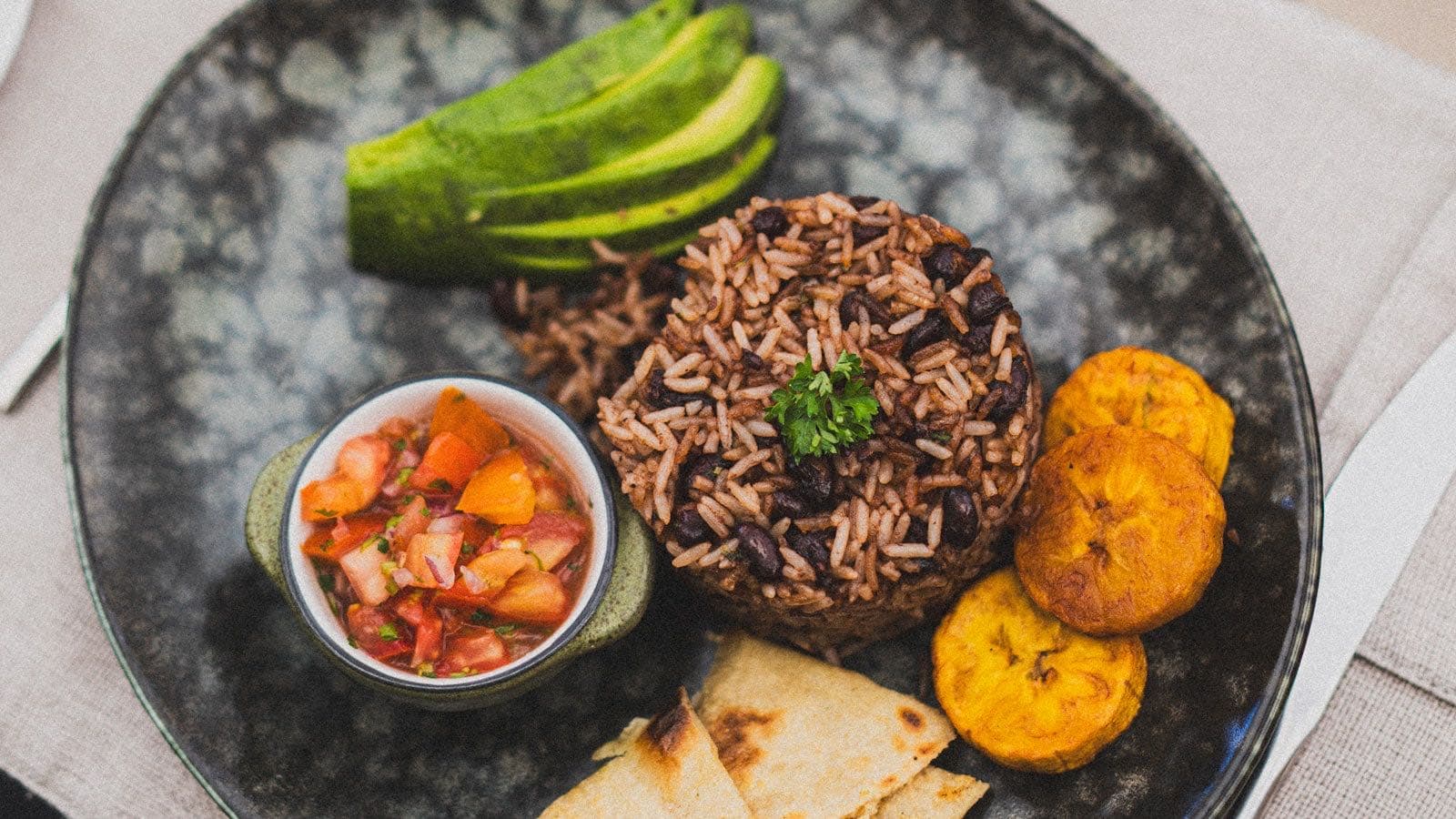
- Sodas (Costa Rican diners). These are the small family-run lunch spots that serve a casado (rice, beans, plantain, salad, protein) for $7–10. They're the soul of Costa Rican food. The owner often doesn't speak English. You can point at the menu and smile — you'll get fed. But basic Spanish unlocks a much warmer experience.
- Local farmer's markets (ferias). Saturday mornings, smaller towns. Most vendors speak only Spanish. A few numbers and "¿Cuánto cuesta?" goes a long way.
- Taxis outside of San José. In the capital, taxi drivers speak some English. In rural areas — Sarchí, Pérez Zeledón, parts of the Caribbean — assume Spanish only.
- Small towns off the tourist circuit. If you're going to Turrialba, Pérez Zeledón, San Vito, or the Osa Peninsula's interior, English drops off fast.
- Buses (public buses). Drivers and conductors speak Spanish. If you're using public transit, basic Spanish helps a lot. Most of our customers skip public buses for this reason — see our shuttle vs Uber vs taxi breakdown for the alternatives.
What kind of Spanish do Ticos speak?
Costa Rican Spanish is clear, polite, and slow compared to other Latin American varieties. We don't use the harsh consonants of Spain or speak as fast as Colombians. If you've taken any Spanish in high school or used Duolingo for a month, you'll understand more than you expect.
A few quirks to know:
- "Pura vida" literally translates to "pure life" but it works as hello, goodbye, thank you, "you're welcome", "no problem", and "I'm great." It is the most useful word in the country. You'll hear it 50 times a day.
- "Mae" is "dude" or "bro." Used constantly between friends. Tourists don't need to use it but you'll hear it.
- "Tuanis" means "cool" or "awesome." A nice substitute for "bueno."
- We use "vos" instead of "tú" sometimes (like Argentinians, slightly different conjugation). You don't need to use vos — "tú" or "usted" both work fine.
- We're famously polite. "Usted" (formal you) is used more often than tú in everyday Tico life, even with friends. Defaulting to "usted" is never wrong.
20 useful phrases
Memorize these and you'll handle 95% of the situations where Spanish is helpful. I've grouped them by use case.
Greetings and basics
- Hola — Hi.
- Buenos días / Buenas tardes / Buenas noches — Good morning / afternoon / evening. You can also just say "Buenas" — most casual short version.
- Pura vida — All-purpose. Use as hello, goodbye, thanks, you're welcome, or "I'm good." Cannot be overused.
- Por favor — Please.
- Gracias — Thanks. Muchas gracias — Thank you very much.
- De nada — You're welcome.
- Con permiso — Excuse me (to pass through a crowd).
- Disculpe — Excuse me / sorry (to get attention or apologize).
Restaurant / soda
- La cuenta, por favor — The check, please.
- ¿Qué recomienda? — What do you recommend? (Magic words at a soda. The owner will pick something for you.)
- Un casado, por favor — A casado, please. (The classic Costa Rican lunch — they'll ask "de pollo, carne, o pescado?" — chicken, beef, or fish.)
- Una cerveza Imperial, por favor — An Imperial beer, please. (Imperial is the most common Costa Rican beer.)
- ¿Tienen menú en inglés? — Do you have an English menu?
Money and shopping
- ¿Cuánto cuesta? — How much does it cost?
- ¿Acepta tarjeta? — Do you accept card?
- En dólares está bien — In dollars is fine. (USD is accepted basically everywhere.)
Directions and shuttles
- ¿Dónde está el baño? — Where is the bathroom?
- ¿Cuánto cuesta el taxi a [place]? — How much is the taxi to [place]?
- Voy a [place] — I'm going to [place].
- Mi hotel es [name] — My hotel is [name].
Bonus
- No entiendo — I don't understand.
- ¿Habla inglés? — Do you speak English?
- Más despacio, por favor — Slower, please.
Print these or save them in your phone. You will use #3 and #5 every day.
Numbers
Knowing 1–20 plus the multiples of 10 makes shopping, restaurant bills, and taxi negotiations smoother:
- 1 uno, 2 dos, 3 tres, 4 cuatro, 5 cinco
- 6 seis, 7 siete, 8 ocho, 9 nueve, 10 diez
- 20 veinte, 30 treinta, 50 cincuenta, 100 cien, 1000 mil
You'll mostly deal in colones (CRC) — current exchange rate is around 500–530 colones per dollar. A 5,000-colón bill is about $10. A 10,000 is $20.
Apps to bridge the gap
- Google Translate. Download the offline Spanish pack before you fly. The camera "point at a menu" feature works really well.
- DeepL. Better than Google Translate for whole sentences.
- Duolingo for two weeks before your trip. Even 15 minutes a day gives you a noticeable boost. The free version is fine.
- WhatsApp. Everyone in Costa Rica uses WhatsApp for everything — hotel confirmations, tour bookings, even doctor appointments. Get it before you arrive.
A note on tipping and politeness
Tico culture is more formal than US/Canadian culture. A few small things go a long way:
- Always greet ("Buenas") before asking a question.
- Smile.
- Don't shout. Even in noisy environments, raising your voice is read as aggressive.
- Tipping in restaurants is already included as a 10% service charge by law. You can add an extra 5–10% for great service. Tipping a shuttle driver $5–10 per person on a long route is appreciated but not required.
You will be treated kindly even with zero Spanish, but you will be treated warmly if you make the effort.
My honest take on the language barrier
In 10 years of driving tourists around Costa Rica, I cannot remember a single guest who couldn't function in their hotel because of language. Costa Rica is one of the easiest non-English-speaking countries in the world to visit.
What I do remember: guests who learned a single phrase ("pura vida," "muchas gracias," "qué recomienda") and got a different reception at small restaurants than guests who came in just speaking English. The difference is real. It's not survival — it's about the quality of the trip.
The people who love Costa Rica the most are the ones who lean into it a little.
What about our shuttles?
If you're worried specifically about communicating with a private driver: don't be. All our drivers speak conversational to fluent English. We pre-arrange the pickup over WhatsApp or email (in English), share flight tracking, and the driver will know your name, your hotel, and any stops you want to make. No Spanish required.
For the difference between hiring a shuttle vs a taxi vs Uber, read our shuttle vs Uber vs taxi comparison.
FAQ
Do most Costa Ricans speak English? In tourist zones, yes — restaurants, hotels, tour guides, and shuttle drivers commonly speak conversational English. Outside tourist areas, English drops off quickly.
Is it rude to only speak English in Costa Rica? Not at all. Costa Ricans are extraordinarily polite and welcoming. That said, a few words of Spanish ("pura vida," "gracias," "buenas") are appreciated everywhere.
What's the easiest Spanish phrase to learn for Costa Rica? "Pura vida" — it works as hello, goodbye, thanks, you're welcome, and "I'm good." Use it constantly.
Do I need Spanish to take a taxi in Costa Rica? In San José, Tamarindo, La Fortuna, and other tourist zones — no. In rural areas, having the address written down on paper or in your phone helps a lot.
Will my drivers speak English? Yes — every driver at a reputable shuttle company in Costa Rica is at least conversational in English. Ours all are.
Do hotels speak English? Almost universally yes, including most $50/night guesthouses in tourist areas. Front desk staff are trained in English.
Is Costa Rican Spanish hard to understand? No, actually one of the easiest Spanish varieties for learners. Slow, clear, less slangy than Mexico or Argentina.
Can I get by with Google Translate? Yes. Download the offline Spanish pack before your trip. The camera "scan a menu" feature is genuinely useful.
Does Duolingo prepare you for Costa Rica? For basic transactional Spanish, yes — restaurant orders, shopping, directions. For real conversation, no, but you won't need conversational Spanish in tourist zones.
Do I need Spanish to read road signs? No. Most highway signs are universal symbols. Distances are in kilometers.
We handle the pickup, the driving, and the Spanish so you don't have to. Every driver bilingual, every shuttle door-to-door.
The airport pickups where having a bilingual driver matters most: